

A group of finance and operations systems built around AI from the ground up has arrived, and between them they have raised more than half a billion dollars since 2024. They are winning customers off NetSuite. We have not implemented any of them, and no client of ours runs one, so what follows is drawn from the vendors' own materials and named third-party sources rather than from experience with the products. What we do bring is the other side of the decision: the mid-market implementations these systems are pitched as replacing.
The category arrives in two halves
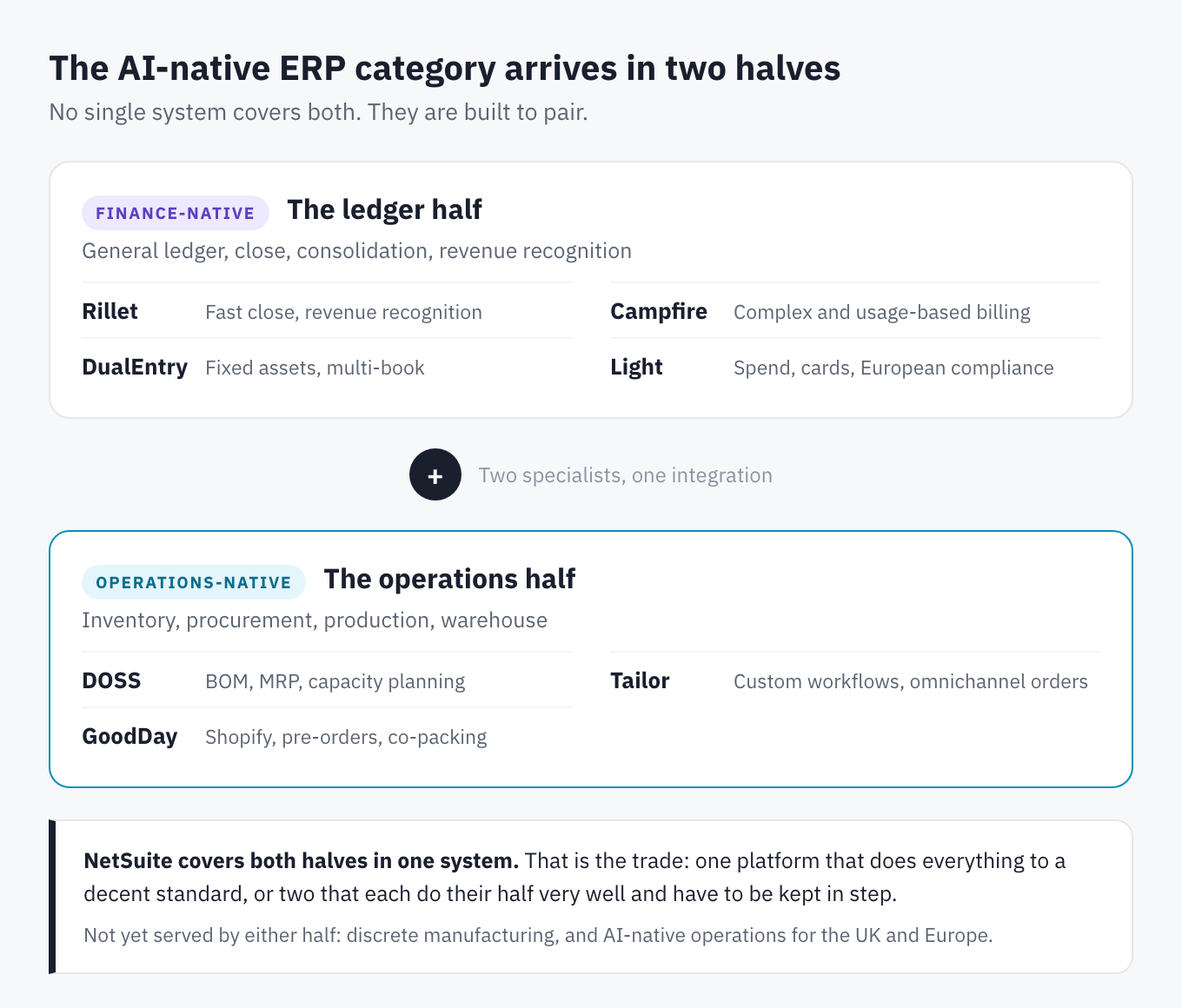
The first thing to understand is that this is not one group of competitors. It is two, and they do different jobs.
The finance-native four
Rillet is built around closing the books fast. It automates the general ledger, matches the large majority of transactions to invoices and bills without anyone touching them, and its agents handle flux analysis, accruals, reconciliation and revenue recognition. Revenue recognition under ASC 606 and IFRS 15 is where it is strongest, which makes it a natural fit for subscription businesses whose revenue schedules currently live in a spreadsheet next to the ERP. You can ask its assistant questions of the live ledger in plain English, and write automation rules the same way. Against NetSuite, the comparison is narrow and deep: it does less, and it does the month-end part faster, with fewer people. EY put its risk and controls practice behind it in April 2026, which for a two-year-old product is the strongest governance signal in this group.

Campfire is the one to look at if your billing is complicated. It handles subscription, usage-based, milestone and hybrid billing, runs invoicing, AR and dunning off the back of it, and carries sub-ledger depth that is unusual at this end of the market, including prepaids and lease accounting. Its Ember agents code uncategorised transactions, match bank lines across currencies, catch duplicates arising from intercompany transfers, and propose month-end accruals for review. It holds SOC 1 and SOC 2, supports SOX controls, and offers granular permissions in the low thousands, which matters if audit is a live concern. Against NetSuite it is aimed squarely at high-growth technology companies whose revenue model changes faster than an ERP configuration can keep up with.

DualEntry is the closest of the four to a conventional finance suite, and the one most focused on getting you off your current system. It carries fixed assets, multi-book accounting, treasury, tax management, allocations and approval workflows alongside the usual ledger and close tooling, which is more traditional finance depth than its peers. Multi-book in particular is the sort of thing businesses normally move up to a full ERP to get. Its automation catches anomalies before you approve a transaction, splits shared costs across subsidiaries automatically, and reads documents into transactions without manual entry. Against NetSuite, its argument is migration: no implementation fee, and your historical data brought across so prior periods stay queryable rather than being summarised into an opening balance.

Light covers the most ground of the four and is the one built for Europe. Alongside the ledger it runs AP and bill payments, AR, expenses, employee and vendor cards, spend management and procurement, so it replaces several tools rather than one. Its consolidation is the best documented in this group: every ledger line carries the transaction currency, the entity's functional currency and the group currency at once, intercompany entries eliminate as they post rather than at month-end, and partial ownership and equity eliminations are modelled in the platform. It pays vendors across 80 or more countries. Its agents code bills, book accruals and clear the bank, with a separate audit agent watching the work of both the agents and the humans, and autonomy gated by materiality thresholds you set. Against NetSuite it is the only one of the four that a UK or European group can seriously consider on compliance grounds, with published statutory tooling for the UK, Germany, Austria, Belgium, Sweden and Ireland.

The operations-native three
DOSS is the most complete of these and the one that goes deepest into making things. It runs inventory, procurement, order management, warehouse and demand planning, and on the production side it imports bills of materials, automates material requirements planning and does real-time capacity planning, including multi-level assemblies, kit breakdowns and made-to-order work. Its warehouse side handles wave planning, pick zones, quality and defect tracking, and generates bills of lading and packing slips. It suits consumer brands with real physical complexity, roughly $20 million to $250 million in revenue, and its customer list leans towards food, drink and personal care. Against NetSuite it covers the operational half at a fraction of the setup effort, and openly hands the ledger to someone else.

Tailor is the one for businesses whose operations do not fit a standard shape. It runs inventory, omnichannel order management, production management, purchasing, cost accounting and warehouse management, but the point of it is that it is headless and composable: you build the workflows your business runs on through APIs rather than configuring someone else's assumptions. Its agents do work like reading a supplier's PDF, comparing it against the purchase order, reconciling the difference and updating the records. That suits retail and ecommerce operations that have outgrown off-the-shelf systems and have the engineering capacity to shape their own. Against NetSuite it trades out-of-the-box coverage for the ability to model your operation precisely. It is available in the US and Japan.

GoodDay Software is the narrowest and the clearest about it. It is built for Shopify brands and does inventory, sales orders, pre-sales orders, purchasing, vendor management, receiving, transfers, returns, shipment tracking and operational accounting. Two things stand out for the businesses it targets: pre-sales order handling, which matters if you run drops or pre-orders, and co-manufacturing and co-packing support, which matters if someone else makes your product. There is no manufacturing, no warehouse management and no general ledger. Against NetSuite its own comparison page is blunt, calling NetSuite "built for slow-moving enterprises, not for fast-growing brands", and for a Shopify-first apparel or consumer brand that argument lands.

| System | What it covers | Best for | Available to |
|---|---|---|---|
| Rillet | Ledger, close, revenue recognition | Subscription businesses wanting a fast close | US, and UK entities inside US groups |
| Campfire | Ledger, complex billing, close, sub-ledgers | Tech companies with usage or hybrid billing | US and UK |
| DualEntry | Ledger, fixed assets, multi-book, treasury | Leaving a legacy ERP without an implementation project | US |
| Light | Ledger, spend, cards, procurement, consolidation | European multi-entity groups | UK, Europe and US |
| DOSS | Inventory, production, warehouse, demand planning | Consumer brands making physical product | US |
| Tailor | Inventory, omnichannel orders, production, costing | Operations that need workflows built to fit | US and Japan |
| GoodDay | Inventory, orders, purchasing, receiving | Shopify brands, including pre-orders and co-packing | US |
They are pairing, not building suites
This is the part worth paying attention to, because it is an argument about how software should be built rather than a marketing position.
DOSS started with its own accounting product and dropped it. Its chief executive Wiley Jones explained the decision plainly: "instead of competing with AI-native companies like Rillet and Campfire, we would rather partner with them, and play a different game." TechCrunch describes the result as "an AI-native inventory management layer that integrates with existing accounting systems, whether traditional ERPs or ones built by AI-based startups".
So none of these seven is trying to be NetSuite. The finance systems do the ledger half well and hand off operations. The operations systems do inventory and production well and hand off the ledger. The intended end state is two specialist products that snap together, each doing its half better than a single suite does either.
That is the opposite of the logic NetSuite is built on, and it is the actual decision in front of a buyer. One system that does everything to a decent standard, or two that each do their half very well and have to be kept in step.
What they do better
Three things stand out.
Implementation cost and time. DualEntry publishes a "$0 Implementation Fee" and puts it at the centre of its pitch, with its own pricing page arguing that NetSuite "typically bills implementation as a separate $75K–$250K project". DOSS is reported as deploying in two to three weeks against four to six months for a traditional ERP. Even allowing for the marketing gloss, and independent reviewers put DualEntry's realistic timeline at four to twelve weeks rather than the advertised days, this is a real commercial difference and it is the single strongest argument any of them makes.
Automation built into the core rather than added later. All seven were architected around OCR extraction, machine-learning transaction coding, automated matching and anomaly detection, rather than having those capabilities added to an existing product. The published customer accounts on close times are striking, and while none of them is independently audited, the direction is consistent across every vendor in the category.
Control models designed for the AI, not retrofitted. Light publishes a materiality-threshold model where work under a set value posts automatically and anything above it needs a controller or CFO to approve, stating that "every action is logged, attributable, and reversible". Rillet describes agents that "propose, you approve, with a full audit trail attached to every action". These are more specific than the category average and they answer the obvious governance objection directly.
What you give up
Four things, in rough order of how much they matter.
- The single system. Pairing a finance product with an operations product means two vendors, two contracts, two roadmaps and an integration to maintain. That integration is the thing an ERP exists to remove.
- UK statutory depth, in most cases. Light is the exception, with published country-specific tooling for the UK, Germany, Austria, Belgium, Sweden and Ireland. Campfire has a London office but names no compliance framework. Rillet is US-first, and its FCA registration covers bank-data access through Plaid rather than the accounting product. DualEntry makes no mention of HMRC or Making Tax Digital. None of the three operations systems has any evidence of UK availability at all.
- Track record. None of the seven appears in a Gartner Magic Quadrant, a Forrester Wave or an IDC MarketScape. Review volumes are small, DOSS has no G2 ratings at all, and press coverage traces largely to funding announcements. This is a function of age rather than quality, but it is a real difference when a system choice has to be justified.
- Operational depth at the deep end. DOSS handles bills of materials, MRP and capacity planning, but has no routings, no shop-floor execution and no manufacturing execution system of its own, and says so. For a discrete manufacturer the gap is wide.
Who should switch
- A services or software business with no stock and simple entities: one of the finance-native four is a credible replacement for what your NetSuite financials do, and the implementation economics are hard to argue with.
- A UK or European group with statutory filing obligations: Light is the only one of the seven with published local tooling, and it is where to start.
- A consumer brand between $20 million and $250 million running inventory: DOSS paired with a finance-native ledger is a real alternative shape, if you are comfortable running two systems.
- A Shopify-native brand: GoodDay is built for exactly that and nothing else.
- A discrete manufacturer: none of these replaces what you run today. The category has not been built for you yet.
- Anyone needing CRM, payroll and finance in one place: the comparison does not start. That is what a suite is for.
The gaps nobody is filling
Two are worth naming, because they say more about where this category is going than any feature list.
The first is discrete manufacturing. Nothing in this group has routings, work-centre capacity, shop-floor execution or lot and serial traceability at the depth a factory needs. The AI-native wave went after the general ledger and after consumer-goods inventory, and skipped the factory floor entirely.
The second is the UK and Europe on the operations side. All three operations systems are US-market. The British and European AI companies working in this space, such as Intropy in London and Plato in Berlin, are building layers over an existing ERP rather than replacing it. If you want AI-native operations and UK statutory compliance in the same system today, it does not exist.
One last thing worth knowing: a domain called ERP.io announced an "AI-Native ERP and PLM Platform for Modern Manufacturers" in September 2026 through a paid newswire, reprinted verbatim across several outlets. It has no disclosed funding, no named customers and no independent coverage. It will rank well for these search terms. Treat it accordingly.
What NetSuite's own AI does
As NetSuite partners we have an obvious interest here, so it is worth being precise about what NetSuite has and what it does not. We have written about this in more depth in our guide to the NetSuite AI Connector Service, which covers how the connector works, what it can and cannot reach, and how it sits alongside NetSuite's built-in AI features.
What it has is breadth and time. Inventory, manufacturing, warehouse, order management, CRM and payroll in one data model, 25 years of deployments, and localisation for the jurisdictions a UK group files in. For a finance director who has to defend a system choice to an auditor or a board, that record is part of the product. On AI specifically, the 2026.1 and 2026.2 releases added Intelligent Close Manager, generative-AI bank matching, flux analysis and EPM reconciliation and planning agents, and the free AI Connector Service exposes NetSuite to Claude or ChatGPT through an open protocol, which is a good piece of engineering.
Three things cut the other way, and a UK reader should know all of them.
SuiteAgents was announced at SuiteWorld in October 2025 and has not shipped. It does not appear in the NetSuite 2026.2 release notes, and it is absent from Oracle's own list of features that use AI. What exists today is an assistant with a human in the loop, plus two agents inside the separately licensed EPM modules. When the challengers say NetSuite's agentic story is a keynote rather than a product, the release notes support them.
NetSuite's AI is metered. Generative AI features consume AI Units, of which 1,000 per user per month are included, pooled across the account and expiring at the end of the term. Oracle's own estimates put a research-grade question at 50 to 200 units, so an enthusiastic user gets through their monthly allowance quickly, and top-ups are sold in blocks. Most buyers assume AI is simply included in the licence. It is included up to a point.
NetSuite Next and Ask Oracle are not available in the UK. Oracle's own announcement of the rollout, dated 15 July 2026, carries one line on availability: "Available to customers in the United States and Canada; additional countries coming soon." No UK date has been published, and the page still reads the same way today. A UK finance team comparing NetSuite's flagship AI against one of these seven systems today is comparing something they can buy against something they cannot.
Where this leaves you
Finance teams are choosing these products, and on the evidence here they are not making an obviously poor decision. If your NetSuite instance is doing financials and little else, the case for looking at Rillet, Campfire, DualEntry or Light is straightforward, and Light in particular deserves a look from any UK group.
The question to settle first is not which system has the better AI. It is whether your business is a ledger or an operation, and whether you would rather run one system that covers everything or two that each cover half exceptionally well. That answer decides the shortlist, and everything else follows from it.
If you are working through that decision now, our NetSuite implementation team can help you scope what a like-for-like comparison looks like for your business. For the established alternatives that cover the full operational footprint, our round-up of NetSuite competitors is the better starting point, and our report on AI in ERP systems covers how the established vendors are adding AI to what they already have.

.png)